
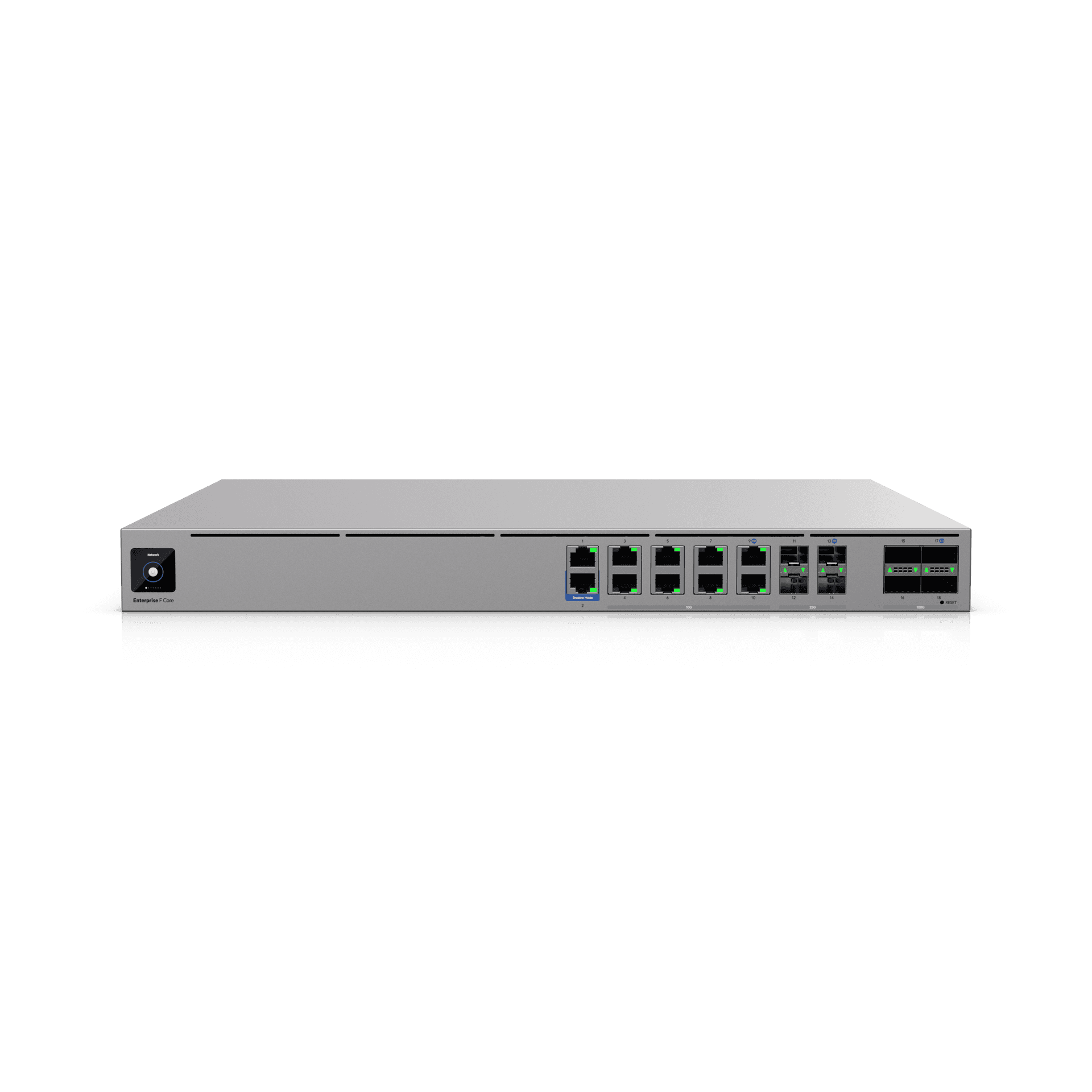
Anyone who has bought an enterprise firewall knows the line item that hurts is not the hardware. It is the licensing. Sonicwall, Fortinet, and Sophos boxes in this performance class run between $20,000 and $40,000 in hardware, then add tens of thousands of dollars more for IDS/IPS, SSL inspection, threat intelligence, and renewals across a five-year window.
UniFi just put a 100 Gigabit firewall on the market for $3,499. License-free. We have one staged on our test bench right now, and the second one shipping into our Atlanta data center for production this week.
The Specs That Matter
The EFG Core is the new top of the UniFi firewall lineup, and the numbers are the headline. UniFi rates it at 100 Gbps cloud-gateway throughput with 75 Gbps of IDS/IPS, 40 Gbps of SSL inspection running license-free, 22,500-plus client capacity, 10.5 million concurrent sessions, and 5,000-plus concurrent IPsec tunnels.
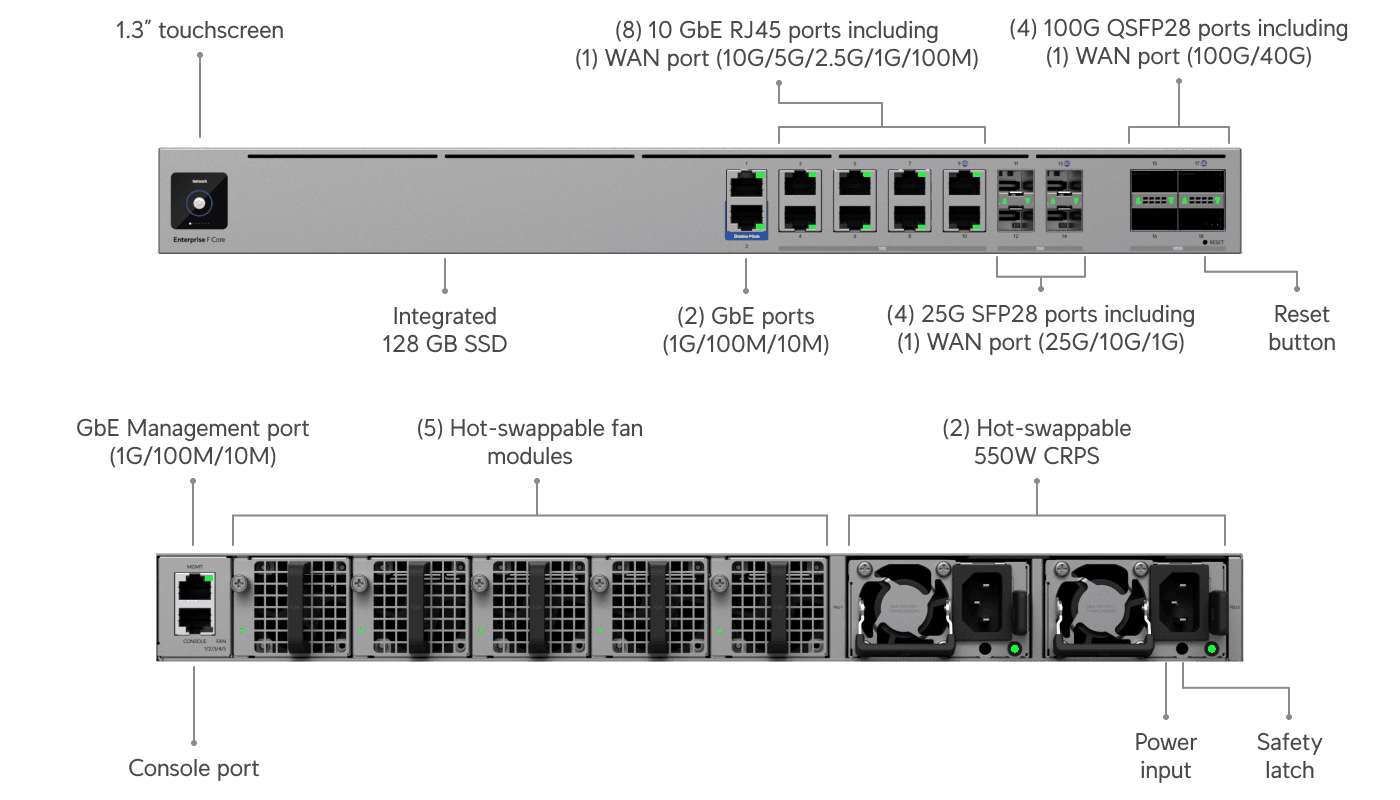
The front panel is where the value shows. You get a 1.3-inch touchscreen and an integrated 128 GB SSD on the left, then a serious chunk of switching: two GbE ports, eight 10 GbE RJ45 ports, four 25G SFP28 ports, and four 100G QSFP28 ports — including one WAN port at each of those four speed tiers. On the back, two hot-swappable 550W power supplies, five hot-swappable fan modules, a gigabit management port, and a console port. Everything redundant. Nothing soldered in place.
The Real Story Is the Total Cost of Ownership
To find anything in this throughput class on the legacy side, you have to climb the ladder all the way to a Sonicwall NSP 13700, a Sophos XGS 8500, or a Fortinet FortiGate 3700F. Meraki does not even have a comparable model — you would step down to an MX 450, which is not really in the same ballpark.
Then you start pricing it out. A Sonicwall NSP 13700 with the security services Ubiquiti includes for free runs between roughly $90,000 and $146,000 over a five-year window depending on bundle. Fortinet and Sophos numbers land in the same range. The EFG Core, by comparison, comes in at $3,499 hardware, plus an optional CyberSecure subscription that brings the five-year total to about $5,994. Even the fully-loaded UniFi number is less than ten percent of a comparable Sonicwall, Sophos, or Fortinet five-year TCO.
The $1,500 step up from the EFG to the EF Core works out to about $25 a month amortized over five years. For 4x the throughput, an order-of-magnitude jump in concurrent sessions, and 4x the maximum site-to-site VPN tunnel count, that is a small upgrade fee for a meaningful capability gap.
Why the UI Matters More Than the Specs
The thing that gets overlooked in firewall comparisons is the operating cost of the people who actually use the box. Sonicwall, Fortinet, and Palo Alto interfaces have always rewarded specialists. The higher up the SKU ladder you go, the more cryptic the configuration UI tends to get, and the more your operational cost concentrates in a small handful of certified engineers.
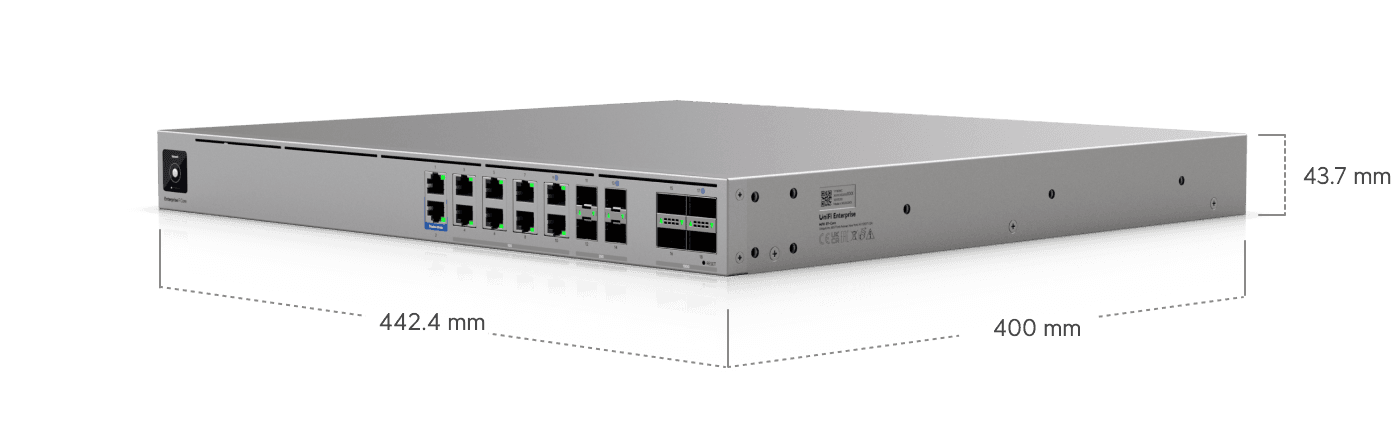
The EF Core runs the same UniFi Network interface that ships on a $379 UCG Fiber, a $1,499 UDM Pro Max, or a $1,999 EFG. We issue every DPC technician a UniFi firewall for their home network when they onboard — by the time they touch enterprise-grade gear at a client site, the interface is muscle memory. That is a real cost savings.
More MSPs are standardizing on UniFi every year for the same reason. Labor is the most expensive line item in a managed services business, and the fastest way to lower it is to standardize on a stack where senior engineers and Level 1 technicians can both move around without re-learning the tools.
Who Should Actually Buy This
The EF Core is not for every business. Walk through these before you spec it in:
- Are you running, or planning to run, sustained 10 Gbps or higher to the WAN? If you are still on a gigabit fiber line and your office traffic averages under 500 Mbps, you are buying headroom you may not use for years. The EFG or UDM Pro Max may be the right fit.
- Do you have multiple sites, a data center, or a hybrid-cloud presence? Site-to-site VPN tunnel capacity, IPsec performance, and SD-WAN orchestration are where the EFG Core's spec sheet really opens up versus its smaller siblings.
- Is your business growing past what a UDM Pro Max can comfortably carry? The UDM Beast covers most small offices easily. Once you are routing for a hundred-plus users on a single site, or you need redundant power and fans for an availability story, the conversation changes.
- Do you want one stack you can scale across all your locations? That is where this gets interesting for MSPs and multi-site businesses. Standardizing on one firewall family across HQ, branch offices, and the data center cuts training, monitoring, and incident-response costs across the board.
If most of those check yes, the EF Core earns its $3,499. If they do not, the EFG at $1,999 or the UDM Pro Max may be the smarter call.
What This Means for Your Network
We are deploying two EFG Cores in high availability at our Atlanta data center. That pair will be customer-facing, fronting the production infrastructure we run for managed services clients. The internal DPC rack will continue to run on a pair of EFGs in HA, which has been rock-solid since we put them in.
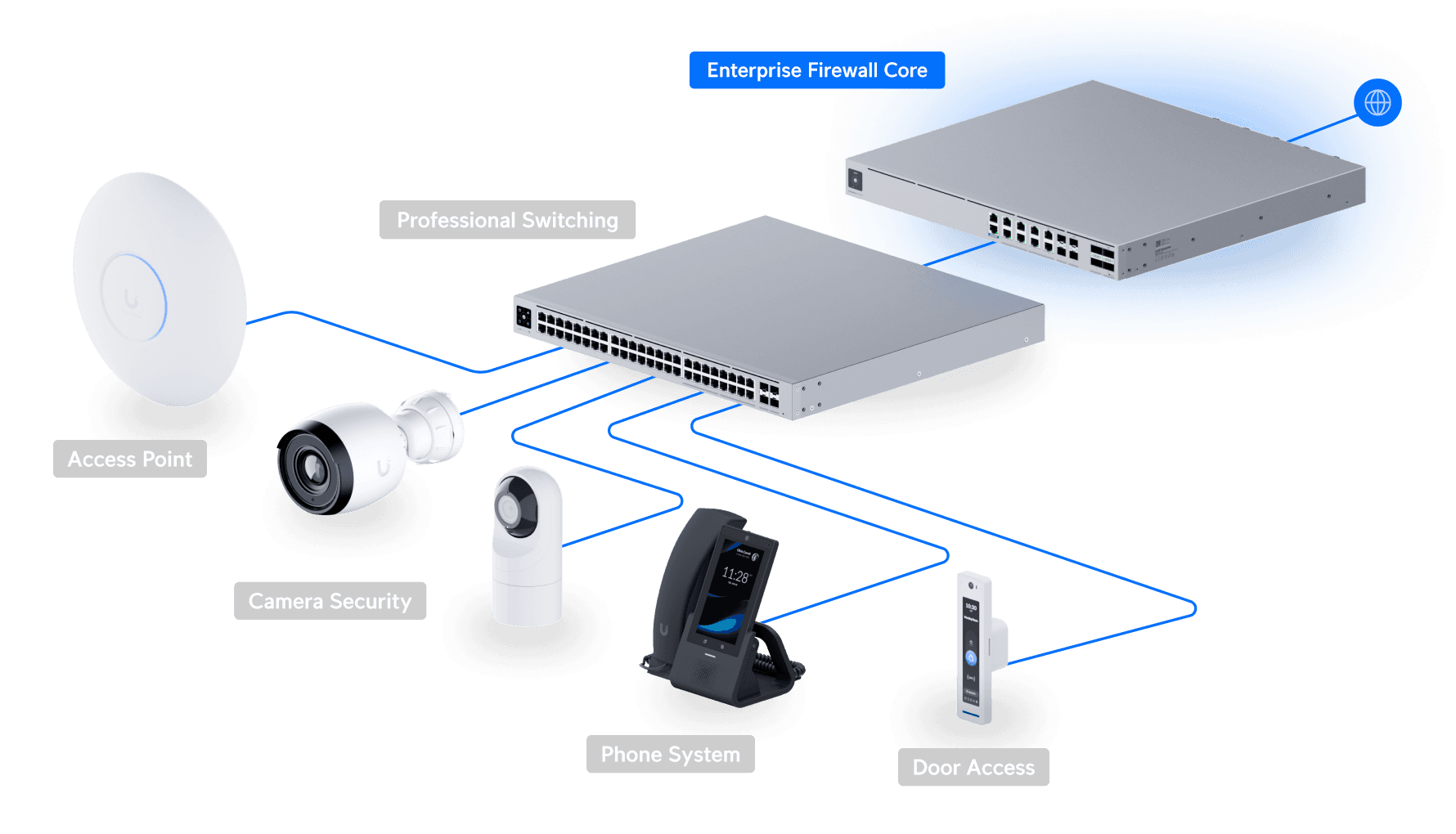
The real story for our clients is the five-year arc. The EF Core has so much headroom that, even for organizations actively upgrading to 25 Gbps and 100 Gbps switching infrastructure over the next several years, the firewall is not going to be the bottleneck. We can design a network around this gear and confidently tell a client it will scale with them for the foreseeable future, instead of planning a forklift upgrade every three years.
There is a cybersecurity story here too. License-free IDS/IPS, SSL inspection, and threat intelligence powered by Proofpoint and Cloudflare mean small businesses can run security capabilities that used to be reserved for organizations with a full-time security engineer and a six-figure budget. That is the part of this release that we think actually changes the market.
Where to Buy
If you are spec'ing UniFi gear for an install, shop the EFG Core through our affiliate link — it supports the channel at no extra cost to you.
DPC Technology has been the trusted IT partner for small businesses across Florida, Georgia, and South Carolina since 1995, with deep specialization in managed IT, cybersecurity, and enterprise UniFi deployments. If your business has 10 or more employees in the Southeast and you're looking for an ongoing managed services partner, give us a call at (844) 260-5020.